What If a Simple Online Workout Could Bring Your Family Closer Together?
You know that feeling when everyone’s in the same house but completely disconnected? Phones in hand, kids on tablets, partners buried in work—family time slips away. I felt the same, until we tried something unexpected: an online fitness class, together. No fancy gear, no pressure—just moving, laughing, breathing. It wasn’t about perfect form or burning calories. It was about showing up for each other. And slowly, something shifted. We started looking forward to those moments. We began talking more. We smiled more. And for the first time in a long while, I felt like we were a team again. That small change didn’t just add movement to our days—it brought us back to each other.
The Invisible Wall in Modern Family Life
It’s strange, isn’t it? We live under one roof, share meals, and care deeply—but sometimes it feels like we’re living in separate worlds. I remember standing in the kitchen one evening, watching my son scroll through videos, my daughter texting a friend, and my partner reviewing emails on his laptop. I called out, “Dinner’s ready,” and got three distracted nods in return. That moment hit me hard. We were all present, but no one was really *there*.
Our days are full, sure—but full of what? Rushing. Reacting. Managing. School drop-offs, work deadlines, laundry, grocery runs, and the endless ping of notifications. The rhythm of family life has become so automatic that we’ve forgotten how to pause and just *be* together. Even when we sit in the same room, our attention is pulled in ten different directions. The silence between us grew heavier, not because we were upset, but because we’d stopped sharing what mattered.
I started noticing how my kids would retreat to their rooms after homework, how my husband and I would exchange only logistics—“Did you pay the bill?” “What’s for dinner?”—instead of real conversation. We weren’t arguing. We weren’t unhappy. We were just… drifting. And I realized that closeness doesn’t just happen. It needs space. It needs intention. But who has time for one more thing? That’s when I began wondering—what if the solution wasn’t another family meeting or a forced game night, but something simpler? Something that didn’t feel like an obligation, but still brought us together?
How a Random Fitness Video Changed Everything
It started with a YouTube suggestion. I was scrolling during a work break, feeling stiff and stressed, when a thumbnail popped up: “Gentle 20-Minute Yoga for Beginners.” I clicked, curious. Within minutes, I was on the living room floor, following a calm voice guiding me through stretches. My daughter walked in, backpack still on, and paused. “Mom, what are you doing?”
I laughed. “Trying not to turn into a robot from sitting all day.” She tilted her head, then said, “Can I try too?” And just like that, she joined me on the mat. We wobbled through poses, giggling when I fell out of “tree pose” and she dramatically overextended “downward dog.” But we finished. And when we lay down for the final relaxation, she whispered, “That was kind of nice.”
The next day, she asked if we could do it again. Then my son wandered in, arms crossed, skeptical. “This looks dumb,” he said. But after two minutes, he was trying the poses too. By the end of the week, my husband glanced over and said, “You three look like you’re having fun. Mind if I squeeze in?” We made space. He was stiff and self-conscious, but he stayed. That one video didn’t fix everything—but it opened a door. For the first time in months, we were doing something *together*, not because we had to, but because we wanted to. And it felt light. It felt good.
Why Online Fitness Fits into Real Life (Without the Pressure)
Here’s what surprised me: we didn’t need any special equipment, extra time, or a big commitment. Online fitness works because it bends to *your* life, not the other way around. A 10-minute stretch between dinner and dishes. A 15-minute dance video after homework. A calming breathing session before bed. These aren’t grand gestures—they’re tiny moments that add up.
And the best part? There’s no pressure. No one’s watching. No one’s judging your form or your pace. You don’t have to wear workout clothes if you don’t want to. We’ve done sessions in pajamas, socks, even with a dog wandering through the frame. It’s not about looking a certain way or hitting a goal. It’s about showing up as you are. That low-pressure environment made it safe for everyone to participate—even my son, who usually avoids anything that feels “cheesy.”
Plus, it’s free or low-cost, and available anytime. We don’t have to drive to a gym, pay for a class, or worry about parking. The barrier to entry is practically zero. And because it happens at home, it’s naturally inclusive. You’re already in the same space. Someone sees you moving, gets curious, and joins. No invitations needed. It’s effortless in a way that other family activities often aren’t. And that ease is exactly what busy families need.
Turning Movement into Meaningful Moments
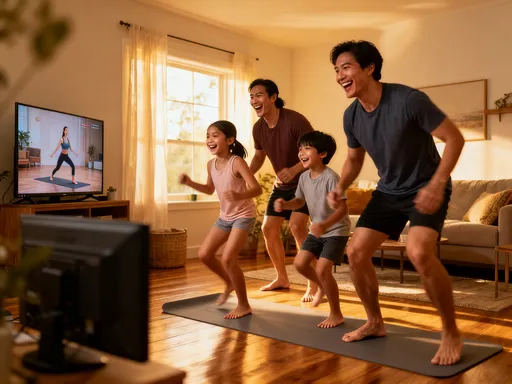
What started as a stretch routine slowly became something more. We began choosing videos together—voting on whether we wanted something energetic or calming. One Friday, we found a “family dance workout” with upbeat pop music and silly moves. We laughed so hard my son actually doubled over. Now, it’s our weekly ritual. We call it “Dance Off Friday,” and no one’s allowed to skip (though participation is still optional—no guilt, just fun).
On quieter nights, we’ll pick a gentle stretching or mindfulness video. Those sessions often lead to the deepest conversations. Once, during a cooldown, my daughter said out of nowhere, “I’ve been kind of stressed about my science project.” We talked about it. Another time, my husband shared that work had been overwhelming. These weren’t forced heart-to-hearts—they emerged naturally from the shared rhythm of movement and breath.
There’s something about moving together that loosens more than just muscles. It opens up space for emotion, for honesty, for connection. We’re not just exercising—we’re building trust. When we laugh at someone’s goofy pose or quietly support each other through a tough stretch, we’re saying, “I’m here. I see you.” And those small affirmations add up. Over time, the energy in our home shifted. We became more patient. More present. More *us*.
Building Routines That Stick—Without Force
Let’s be real: most family routines fall apart because they feel like chores. We try to eat dinner together every night, but someone’s late. We plan game nights, but someone’s too tired. The pressure to “do it right” kills the joy. What made our fitness habit stick wasn’t discipline—it was *delight*.
We didn’t force anything. If someone wasn’t in the mood, they didn’t have to join. No guilt. No lectures. We celebrated showing up, not performance. Sometimes only two of us would participate. Sometimes all four. The goal wasn’t consistency in attendance, but consistency in invitation.
We also made it fun. We’d pick videos with themes—“superhero stretches,” “animal yoga,” or “dance like no one’s watching.” We used a shared calendar to mark “family movement time,” but treated it like a gentle reminder, not a rule. And we kept it short—never more than 20 minutes. That way, it never felt like a burden.
Over time, it became as natural as brushing our teeth or sharing a meal. We didn’t even think about it anymore. It was just part of how we lived. And that’s the secret: habits that last aren’t built on willpower. They’re built on joy, ease, and belonging. This wasn’t about fitness. It was about creating a ritual that said, “We matter. We belong. We’re in this together.”
How Small Shifts Create Big Emotional Gains
The changes didn’t happen overnight. But slowly, I noticed I was calmer. I wasn’t snapping as much when the dishes piled up or the dog tracked mud in. My kids seemed more open—they’d come to me with little worries or share funny stories from school. My husband and I started having real conversations again, not just logistics. We’d talk about our days, our hopes, even our fears.
I later read that shared physical activity can boost oxytocin—the “bonding hormone”—and lower cortisol, the stress hormone. But I didn’t need a study to tell me it was working. I could feel it in the way my daughter hugged me longer, in the way my son started asking me to watch videos with him, in the way my husband and I began laughing together at dinner.
Our sleep improved. Our moods lifted. We argued less. And when tensions did rise, we were quicker to repair. It was like the small act of moving together had reset something in all of us. We became more emotionally available. More resilient. More connected. The online class wasn’t the magic. The magic was in the shared presence—being in the same room, breathing together, moving together, choosing each other again and again.
Your Turn: Start Small, Stay Together
If you’re reading this and thinking, “That sounds nice, but my family would never go for it,” I get it. I thought the same. But you don’t need a perfect plan. You don’t need everyone to buy in right away. Just start with one video. Ten minutes. Any style—yoga, dance, stretching, tai chi, even a guided meditation with gentle movement.
Play it in the living room. Do it alone at first, if you have to. Let someone notice. Let them laugh. Let them say, “That looks weird.” Then say, “Want to try?” Keep it light. Keep it kind. Celebrate the attempt, not the outcome. If someone falls over, laugh with them. If someone walks away, no pressure. Just keep showing up.
Over time, you might notice someone lingering. Then joining. Then asking, “Can we do it again?” And one day, you’ll realize something quiet but powerful has shifted. You’re not just sharing a house. You’re sharing moments. You’re building a rhythm of togetherness. You’re creating a family culture where connection isn’t an event—it’s a habit.
Technology often gets blamed for pulling families apart. But in this case, it did the opposite. It gave us a simple, accessible tool to come back to each other. We didn’t need a retreat or a vacation. We didn’t need to fix anything. We just needed to move—side by side, breath by breath, heart to heart. And sometimes, that’s more than enough.